Indian Rocks Beach vs. Belleair Shore: Why the Beaches Look So Different
Walk north along the Gulf and the change in the beach is surprisingly easy to see.

Beach nourishment, private property, and one of our favorite walks north of Indian Rocks Beach
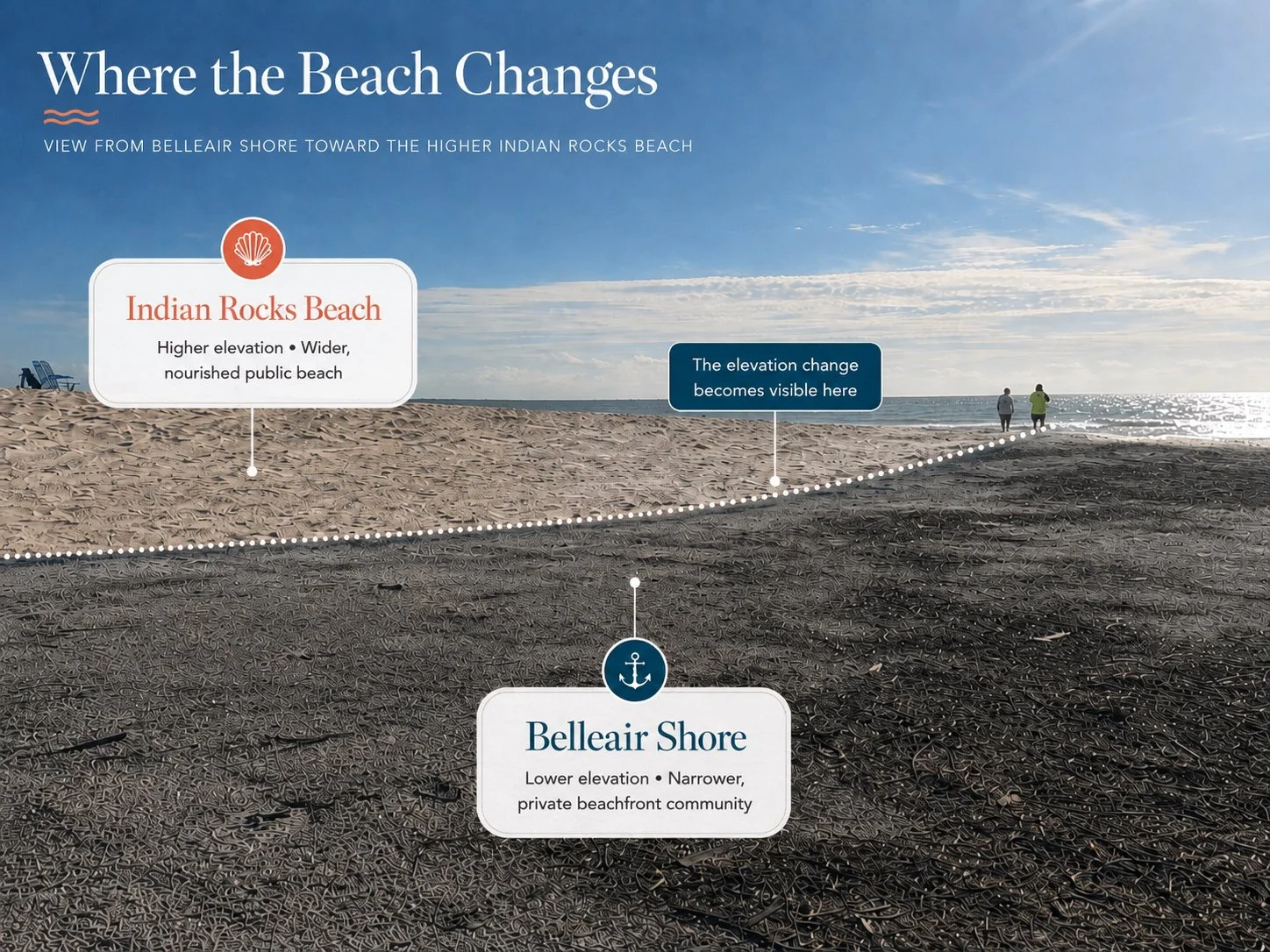
Walk north along the Gulf from Indian Rocks Beach, and the change in the shoreline becomes surprisingly easy to see.
The broad stretch of sand in Indian Rocks Beach gradually gives way to a quieter coastline where the Gulf sits much closer to the beachfront homes. There are fewer people, fewer umbrellas and beach setups, and a noticeably different feel.
It isn't your imagination.
These neighboring stretches of coastline have different histories, different property-ownership patterns and different approaches to beach nourishment.
Understanding those differences makes the walk more interesting — and helps visitors enjoy both communities respectfully.
First, a Common Mix-Up: Belleair Beach Is Not Belleair Shore
This is worth clearing up because even people familiar with the area sometimes use the names interchangeably.
Belleair Beach and Belleair Shore are separate municipalities.
Belleair Beach is north of Belleair Shore and, like Indian Rocks Beach, participated in Pinellas County's major 2025 beach nourishment project.
Belleair Shore is the distinctive residential stretch between the two.
That distinction is important because Belleair Shore's beachfront property ownership is very different from what visitors encounter on most surrounding beaches. The Town explains that its residents' property deeds extend beyond their seawalls into the sandy beach area and that this ownership structure has excluded Belleair Shore from publicly funded beach renourishment projects.
Same Gulf. Different Beaches.
A relaxed beach community with a broad shoreline that received significant new sand during the 2025 Pinellas County nourishment project.
A quiet residential community with an unusual private beachfront ownership structure and a shoreline that was not part of the publicly funded nourishment project.
A separate community north of Belleair Shore that also received sand during the 2025 Pinellas County nourishment project.
Pinellas County's completed 2025 project specifically included Indian Rocks Beach and Belleair Beach among the Sand Key communities receiving new sand.
Why Is Indian Rocks Beach So Much Wider?
Beaches are never static.
Waves, tides, currents and major storms continually move sand. So the width of any Florida beach can change over time, and even from one season to another.
But one major reason today's contrast can be so noticeable is beach nourishment.
In 2025, Pinellas County undertook a major emergency nourishment project following years of erosion and significant storm impacts. The completed project placed sand along portions of Sand Key, Treasure Island and Upham Beach, including Indian Rocks Beach. More than 2.5 million cubic yards of sand were expected to be placed during the overall project.
Indian Rocks Beach received its sand during November and early December 2025, and the overall project was completed in February 2026.
The difference is easy to see today.
There is considerably more sand between the Gulf and the homes, streets and infrastructure behind the beach.
And while having more room for beach chairs is certainly a nice benefit, recreation isn't the only reason nourishment matters.
Florida defines beach restoration as placing sand on an eroded beach both to restore the recreational beach and to provide storm protection for upland properties.
A wider beach is part playground and part protective infrastructure.
Visitors Helped Make It Possible
Here's something many people vacationing in Indian Rocks Beach don't realize:
You helped pay for this beach.
Pinellas County's completed nourishment project cost approximately $125.7 million and was supported by the county's Tourist Development Tax together with State of Florida grant funding. Pinellas County described the project when construction began as being funded mostly through the hotel or bed tax paid by visitors, plus state funding.
That Tourist Development Tax is the tax collected on short-term accommodations such as hotels and vacation rentals throughout Pinellas County.
So if you've vacationed here, there's a good chance you've contributed.
Thank You for Helping Take Care of Our Beaches
When you choose to vacation in Pinellas County, you do more than support our restaurants, shops, vacation rentals and other local businesses. Tourism tax generated by overnight stays also helps fund investments in the coastline itself. So, genuinely, thank you. Visitors are part of what makes projects like the restoration of Indian Rocks Beach possible.
We think that's a nice part of the tourism story.
The people who come here to enjoy the Gulf also help support the community and the beaches that bring all of us here in the first place.
Why Belleair Shore Is Different
Belleair Shore has a very different Gulf-front environment, and its unusual private-property structure plays an important role in that difference.
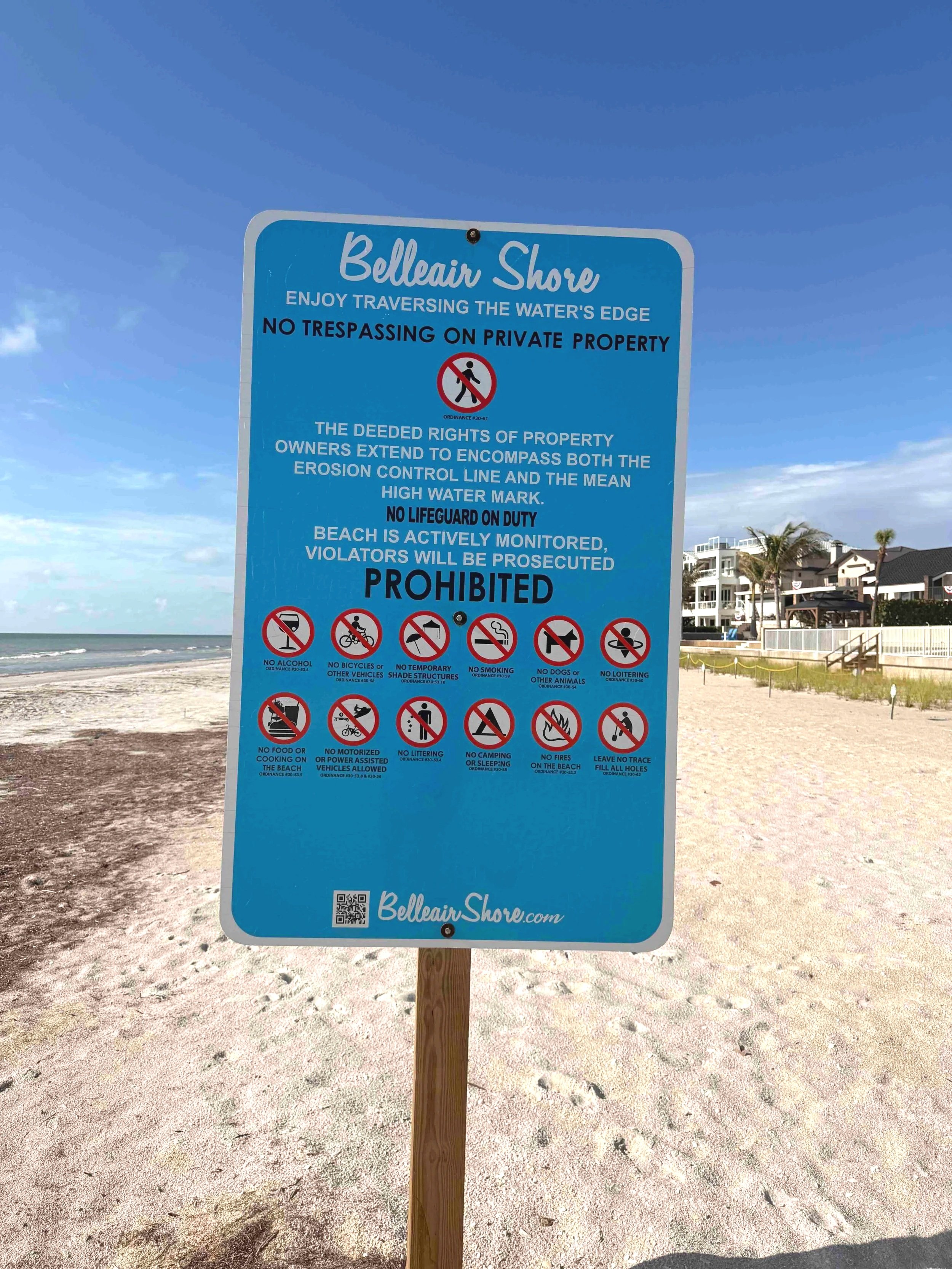
According to the Town of Belleair Shore, beachfront property deeds extend beyond residents' seawalls into the sandy beach area. The Town states that the deeded rights of property owners encompass both the erosion control line and the mean high-water mark.
Because of that private ownership structure, Belleair Shore says it is excluded from publicly funded beach nourishment projects intended for public coastal areas.
That's one important reason the physical transition can be so striking when you're walking the coastline.
But there is another side to the story.
Belleair Shore's lack of a wide, heavily used public beach is also part of what gives the community its distinctive character.
It is exceptionally residential. It can be remarkably peaceful. Gulf-front homes sit close to the natural shoreline, and there are often long stretches with very few people.
It's a different beach experience — not necessarily a lesser one.
“Enjoy Traversing the Water's Edge”
We particularly like the wording Belleair Shore uses on its beach signs because it communicates both hospitality and boundaries.
At the top:
“Enjoy traversing the water's edge.”
Immediately below it:
“No trespassing on private property.”
That's a good way for visitors to think about Belleair Shore.
The community isn't asking people not to appreciate its coastline. It's asking people to recognize that this particular stretch of beach has private-property rights that aren't necessarily obvious just by looking at the sand.
The Town says its beach ordinances are designed to protect natural resources, safeguard the rights of property owners and promote safe use of the beach.
We think those objectives deserve respect.
A beach can look open while still containing privately owned property.
So rather than trying to determine precisely where a surveyed property line may be while you're enjoying your vacation, there is a much easier approach:
Enjoy the water's edge and respect the private property behind it.
That's good beach etiquette anywhere — and particularly important in Belleair Shore.
What About the Mean High-Water Line?
Florida beach-property law can become complicated quickly.
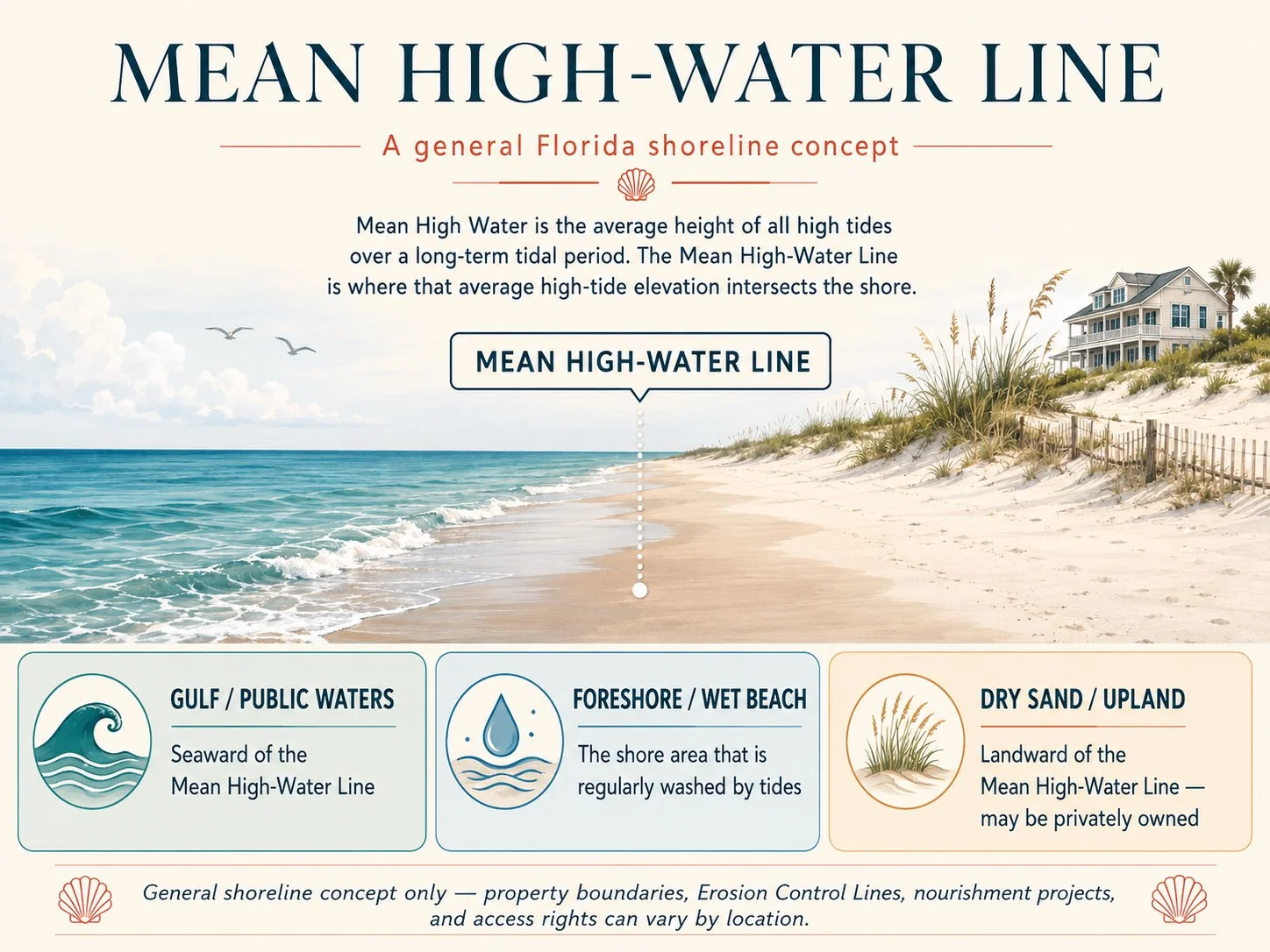
As a general matter, Florida recognizes the mean high-water line as the boundary between state-owned sovereign foreshore and upland that can be privately owned. Beach-restoration projects can introduce additional concepts such as an established erosion control line.
Belleair Shore's circumstances are unusual enough that we don't recommend visitors trying to interpret those legal boundaries themselves.
The Town specifically states that its owners' deeded rights encompass both the erosion control line and the mean high-water mark and posts signs directing walkers to stay off private property.
For someone taking a beach walk, that's really all you need to know.
Stay near the water.
Respect the homes, seawalls and private beach areas.
Enjoy the view.
Can You Put Up an Umbrella or Beach Shade in Belleair Shore?
This is another subject where you'll sometimes hear an overly simple answer.
The current rules are more nuanced.
Belleair Shore prohibits tents, canopies, temporary shade structures and recreational structures within its designated beach-access lots 21, 43 and 66, with an exception for a traditional single-pole umbrella no more than 7½ feet in diameter and with a pole no longer than eight feet.
Residents and homeowners have separate provisions that allow certain temporary shade structures on the beach areas behind their homes for limited periods.
So it isn't accurate to simply say:
“Belleair Shore doesn't allow umbrellas.”
It is more accurate to say that Belleair Shore has specific rules governing beach equipment and that private beachfront property shouldn't be treated as an open public setup area.
For a visitor, our recommendation is much simpler than the ordinance:
Beach in Indian Rocks Beach. Walk Belleair Shore.
If you're planning to bring the beach wagon, spread out the chairs, open your shade and settle in for several hours, Indian Rocks Beach is designed for exactly that type of day.
Belleair Shore offers something different.
Can You Stop or Sunbathe There?
Again, we wouldn't try to turn this into a legal-property-line exercise.
There are Town-controlled access areas with their own rules, and there is privately owned beachfront property.
What you should not do is assume that an empty-looking patch of dry sand in front of someone's Belleair Shore home is automatically a public place to establish your beach setup.
The homeowners have real property rights there, and the Town takes those rights seriously. Its signs note that the beach is actively monitored and warn against trespassing.
That's reasonable information for visitors to have before they arrive — rather than learning it after unintentionally setting up in the wrong place.
Fortunately, you don't need to set anything up to enjoy one of Belleair Shore's best features.
Belleair Shore Is a Wonderful Walk
This might be our favorite part of the story.
Belleair Shore can be one of the nicest stretches of coastline around for a peaceful walk.
Because it doesn't have the same concentration of traditional public-beach activity, it is often noticeably quieter than Indian Rocks Beach.
You can walk beside the Gulf, admire some of the area's beautiful beachfront architecture, look for dolphins offshore, watch shorebirds working the waterline and enjoy a stretch of coast that feels unusually peaceful for Pinellas County.
Morning can be especially beautiful.
So can sunset.
And rather than looking at the narrower beach as something Belleair Shore is missing, it's worth appreciating what the community does offer:
quiet, privacy and a distinctly residential Gulf-front character.
That is worth preserving too.
Know Before You Walk North
Enjoy the Water's Edge
Belleair Shore itself encourages visitors to enjoy traversing the water's edge. It's a particularly peaceful extension of a morning or sunset walk.
Respect Private Property
Open sand isn't necessarily public sand. Give Gulf-front homes, seawalls and privately owned beach areas the same respect you would any other private property.
Keep the Beach-Day Setup in IRB
Indian Rocks Beach is the simpler choice for chairs, umbrellas, beach wagons, children playing and spending several hours in one spot.
Enjoy What Makes It Different
Don't rush through. Belleair Shore's quiet, residential character is exactly what makes this stretch of coastline such an enjoyable walk.
Belleair Shore currently publishes additional rules concerning food, alcohol, animals, smoking and vaping, vehicles, fires and other activities, so directing visitors to the Town's current information rather than reproducing every ordinance keeps this guide useful even if individual regulations change.
Two Neighboring Beaches. Two Experiences Worth Appreciating.
Indian Rocks Beach and Belleair Shore share the same Gulf of Mexico and sit only a short distance apart.
Yet they illustrate two very different relationships with the shoreline.
Indian Rocks Beach has benefited from substantial public investment in beach nourishment. Today it offers the broad sandy shoreline most visitors imagine when planning a Gulf Coast beach vacation.
Belleair Shore has a distinctive private-property structure that has kept it outside publicly funded beach nourishment. Its narrower and quieter shoreline is closely connected to private Gulf-front residences, and the community asks visitors to respect that relationship.
We appreciate both.
And we especially appreciate that you can experience the difference simply by walking up the beach.
Indian Rocks Beach is where we'd spend the beach day.
Bring your chairs. Open the umbrella. Let the kids play. Stay for sunset.
Belleair Shore is where we'd continue the beach walk.
Enjoy the quiet. Admire the homes. Watch the Gulf. Respect the private property around you.
Then turn around and walk home along the same water's edge.
It's one of those small local experiences that helps you understand this part of Florida a little better.
And that's exactly the kind of thing we want to share in the Condo Del Mar Insider's Guide.
Additional Reading:
Make Indian Rocks Beach Your Home Base
Stay just across Gulf Boulevard from the beach and use Condo Del Mar as your home base for beach days, sunset walks, local restaurants and the quieter corners of the Gulf Coast you might otherwise miss.
Local regulations, beach conditions and property boundaries can change. This Insider's Guide is intended to help visitors understand and respectfully enjoy the area, not to provide legal advice. Follow posted signs and current municipal regulations whenever visiting neighboring communities.